
The Far Side
of the Line.
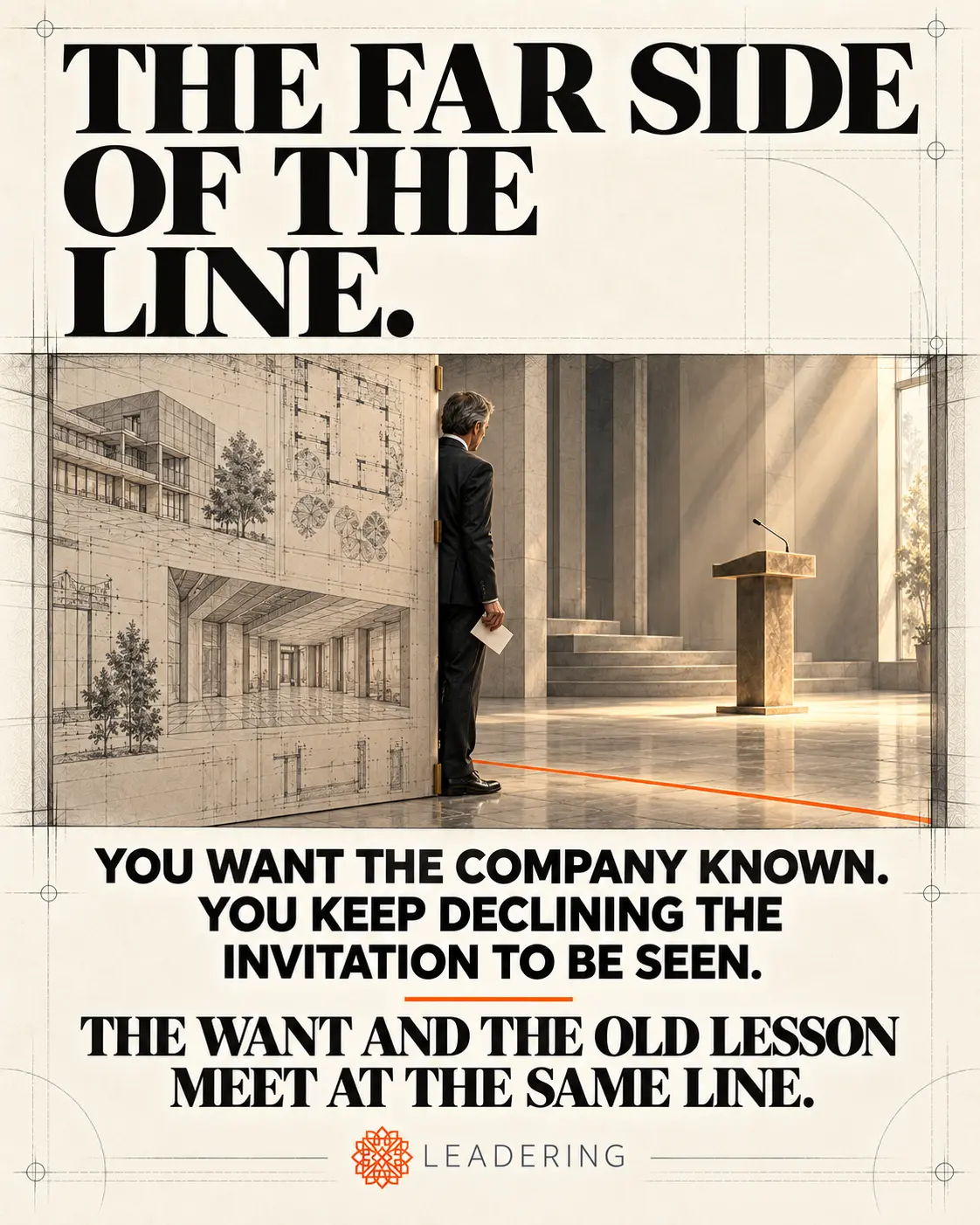
Say you want the company known for its work. Not only by customers. By the industry. You have said it out loud in planning sessions. It is in the deck.
Then the trade association asks you to keynote. You pass. A publication wants a profile. You hand them your head of product. A podcast reaches out. You will get to it. Each time there is a reason, and each time the reason sounds like priorities. You are heads down. The work should speak for itself.
Here is the thing to look at. A company known across its industry means someone standing in front of it. It means being seen, and judged, by people who do not already like you. You cannot have the one without the other. And being seen is the exact thing you have arranged your whole life to avoid.
That is not a coincidence.
A long time ago, something happened when you were seen. Maybe you were looked at and found wanting. Maybe you were noticed at the wrong moment, by the wrong person. You do not remember deciding anything about it. You learned, below words, that standing out costs something, and from then on you built where you could stay behind the work. You got very good at it. The work got good enough to speak for itself, most of the way.
What you want did not form at random either. It formed on the far side of that line, because that is where the unlived part of your life is waiting. The want points at the line from one side. The old lesson holds it from the other. You stand between them every time the invitation arrives, and every time, the reason that sounds like priorities is the old lesson, arriving on schedule.
This is why the things you want most in the company are so often the things you have been avoiding for forty years. The lesson was built around whatever came close to the original pain. The want grows toward it. They meet at the same line. If the pain came from being seen, the want is to be known. If it came from needing someone who did not come, the want is a partnership that works, which means needing someone. If it came from being wrong in front of people, the want is a company where hard things get said early, which means being wrong in front of people.
So look at what you have said you want. Then look at what you keep finding reasons not to do. Where the two point at the same line, you have found it. Not a motivation problem. Not a timing problem. An old lesson doing its job, standing in front of the one thing you asked for.
You will not get past it by deciding to. You get past it by seeing the reason for what it is the next time it arrives, and then choosing with your eyes open.
Back to all articles