
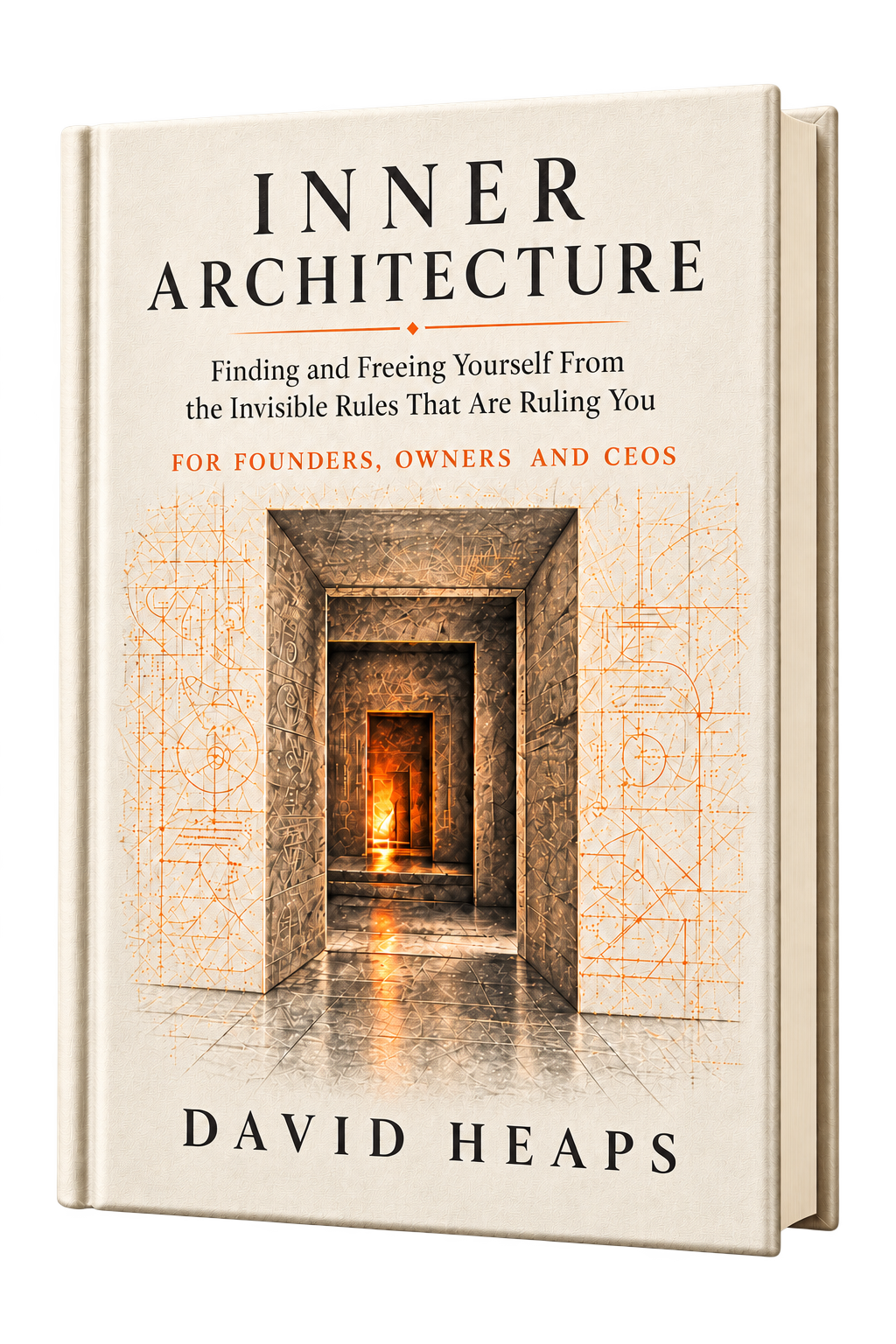
I wrote this for the person who built something. The founder, the owner, the CEO, the one who runs the thing, who has more leverage over the world around them than almost anyone they know, and who has still hit the one wall that leverage does not move.
The wall is a single thing you cannot make yourself do, or cannot make yourself stop doing, no matter how plainly you see it or what it is costing you and the people who depend on you. You can hire and fire, raise and build, burn it down and start over. You have proven, many times, that you can make almost anything happen in your world. And then there is this one thing, and it does not move.
It takes a different shape in every founder, and it hides behind everything that is going right. One cannot let go: he hires people more capable than himself, then overrules them until they shrink into needing him to catch everything they drop. One cannot make the call: she has kept someone the company has outgrown, and rather than face what it is costing, she allows the misalignment to undermine the culture she is trying to build. One cannot hear it: no one on his team will bring him bad news anymore, and he reads the silence as agreement. One cannot stop: she works past what her body can take until it begins to turn on her, and calls it discipline. One cannot say it: she has let someone fail for a year rather than have one honest conversation that would have turned it around. One cannot hold anyone to anything: work gets promised and dropped with no consequence, and he quietly redoes it himself instead of holding anyone to the standards that keep the company on course. Not all of these are yours. At least one of them likely is, and you have known it for years. Knowing has not been enough to change it.
You have more power over your world than you have over yourself. That distance is what this book is about.
You are smart enough to know the same thing keeps going wrong across people and situations that have nothing in common but you. You are just too close to see what is driving it.
What is driving it started long before the company, and long before anything you are dealing with now. When you were small, something hurt in a way you could not make sense of, and you made sense of it the only way a child can: by deciding something about yourself. You did not choose what you decided. You were young, and you understood very little about the world and your place in it. A mind that young, trying to explain something painful, almost always lands on the least charitable explanation there is. That you were not enough, or too much, or on your own. That being seen all the way through was dangerous. A child cannot live with a conclusion like that out in the open, so your mind went to work keeping you away from it, and what it built I call operating rules. The term will get a chapter of its own. An operating rule is never written down and never announced. It does not feel like a rule at all. It feels like good judgment, like your personality, like just the way things are. It decides what you will say and what you will swallow, which conversations you will have and which you will keep putting off, whom you trust and how far, all so that the conclusion underneath is never touched again. It has had a hand in nearly every choice you have made since, and it has never once told you it was there.
Those conclusions, and the rules built to guard them, are the heart of what I call the inner architecture. Put more plainly, it is your defense system, together with what it was built to defend. It is built in layers, and there is more to it than these two. The book takes it one level at a time. The conclusions are part of the foundation, laid when you were a child, by a child. The rules are the wiring, run through the walls before you can remember, out of sight, deciding what turns on and what stays dark. Everything else, the company, the relationships, the way you lead and decide and react, is the house that went up on top. You did not knowingly design any of it. You have been living inside it your whole life, which is why no amount of intelligence has shown you the shape of it. The wall you keep hitting is one of its walls. You cannot see the shape of a house from one room inside it. Seeing it takes a method.
Here is the shape of the wall, now that you can see what it is made of. You built the business to become something. Every founder carries a picture of that, clear or vague: the customers it will attract, the value it will provide them, the profit that lets it keep going, the growth, and the shape of your own involvement at the end of it, anywhere from running it every day to having something ready to sell at the time of your choosing. All of those aims are legitimate, and every one of them requires certain things of you. Certain conversations. Certain decisions. Certain ways of showing up. Without them, what you are building cannot become what you want it to be.
The wall is the place where what the business needs from you and what the rules will allow point in opposite directions, and the rules win. Not sometimes. Every time one fires and you obey it, because obeying it feels like relief, and the cost arrives later wearing a different name. The business is not the only place this can happen. For some people the same collision runs through a marriage, or their health, or something else that matters deeply to them, or through all of those at once. For others it stays almost entirely at work. Where it shows up depends on which rules you carry and what your life keeps putting in front of them. This book focuses on the business because I wrote it for the people who build and run one, and for them, the business is where the wall shows up most often. If you picked up a book like this, that is very likely where you have been hitting it.
People have a phrase for this. They say a leader is getting in their own way. The phrase is right, as far as it goes. It just stops before the hard part: what the way is made of, where it came from, and why you cannot simply step out of it. There is a question hiding in it that the phrase never asks. If there is only one of you, why does it so often feel like there are two, wanting opposite things at the same time, and the one you did not choose keeps winning? Chapter one answers it, and the rest of the book is about what to do with the answer.
That is what this book is: a method for seeing the rules that have been ruling you, for seeing where the choices they make for you collide with what you are trying to build, and for changing what they get to decide. Not by declaring war on them. By learning to see the collision earlier, and in quieter moments, and to understand what the rules have been protecting you from, until the choices the rules have been making for you, the ones that keep steering the business away from what you want, are finally yours to make.
Let me fill that in, what it is and what it is not, so you are not left to assemble it yourself.
This is not an academic book. I am not a psychologist, and I do not write like one. You will not find studies cited, clinicians quoted, or theories defended. What is here comes from somewhere more direct: my own work on myself, and years of coaching founders, owners, and CEOs through the same work. I have done it on myself and guided many others through it, until the shape of it became undeniable. This is practice, not theory.
This is not a book of tactics. It is a book of method. There are steps, there are stages, and there is practice. What there is not is a shortcut. A tactic changes what you do. It does not ask why. And a tactic has to be held up by constant effort, until it runs out, as it often does, and you slide back down to where you began. Understanding takes no holding. Once you understand why, there is nothing to grip and nothing to fall from. You are not white-knuckling a new habit you hope will take root. You do it because you understand it, not because you are forcing yourself. That is what this book is for. The leadership shelf will sharpen how you operate, and it is good at that, but it stops at the wall this book is about. This is the book underneath that one, written for the operator who would never pick up a book about their inner life, the one who prides themselves on not needing it. That is usually the person the rules run most completely.
Here is what I would want to know going in.
The work runs through the body before it runs through the mind. You will be asked to investigate sensations, to slow down, to stay with what you would normally try to fix and move past on instinct. For a person who built a life out of moving fast, that is going to feel wrong the first time you hit it. I am telling you now, so that when it feels wrong, you know it is the work and not a detour. The results do come. They come on their own, once the choices the rule has been making for you start being yours. If you need them to come first, you will quit before they arrive.
Expect your defense system to push back. It was built to keep you away from the conclusions you drew about yourself as a child, and from anything that comes near them, and it cannot tell the difference between a real danger and you, reading this book, getting close to them. When you start to look, the looking will feel dangerous, or wrong. So will moving toward what it was built to keep you away from, and so will the hours after you do. None of that is a verdict on the work. It is the system doing what it was built to do, and chapter nine will show you how to meet it. Later you will see something stranger: some of that discomfort turns out to be the clearest sign you have that you are moving in the right direction.
And I am not going to help you remove the rules, or the beliefs underneath them. Neither one can be removed. What changes is your relationship to them, and with it your passive obedience to them. You will still hear the rule. You will simply stop taking it as an instruction every time it speaks. The old wiring keeps its place in the walls, but it stops having the final say in what you do, and in who you are. That is less than you may be hoping for and far more than you think. It is the difference between a life that rules you and a life you choose.
What I am about to show you, I did not find in a book or a boardroom. I found it in silence.
Over four years, in stretches of three to six months, I lived alone in the Amazon, in near-total isolation. The better part of a year and a half, all told. One simple meal a day. No phone, no books, no music, no one to talk to and no one to perform for. Just me and what was underneath. Nothing left to put between us.
What I found there was not exotic. It was the opposite. With everything stripped away that normally keeps a person from looking inward, I began to see what had been making my decisions my whole life, and it was not who I thought it was. The choices I believed I was making freely had been made long ago, by a much younger version of me, for reasons I had never thought to examine: a handful of conclusions I drew about myself before I was old enough to know better, and a set of rules my mind built to guard them and never mentioned to me again.
You do not need the jungle. The conditions that let me see my own inner architecture, the silence, the stillness, the removal of the usual hiding places, can be built into an ordinary life by anyone willing to turn and look. This book is the turning and the looking, put into a form you can use without leaving your life to do it.
A word on what I do not lead with. I have teachers and traditions that have helped shape how I came to understand all of this, and they are not on these pages, by choice. What is on these pages is the part I can hand you plainly, without asking you to adopt anything, believe anything, or follow me anywhere. You can take all of it and stay exactly who you are.
The work in this book is also not something I am handing down from the far side of it. I am still in it. As far as I can see, the work does not end. I am not writing to you from the end of the road. I am writing to you from a little further down the same road you are on, turning back to tell you what I have found so far.
Let’s begin.
Return to the book