
The Myth of
Replacing Beliefs.
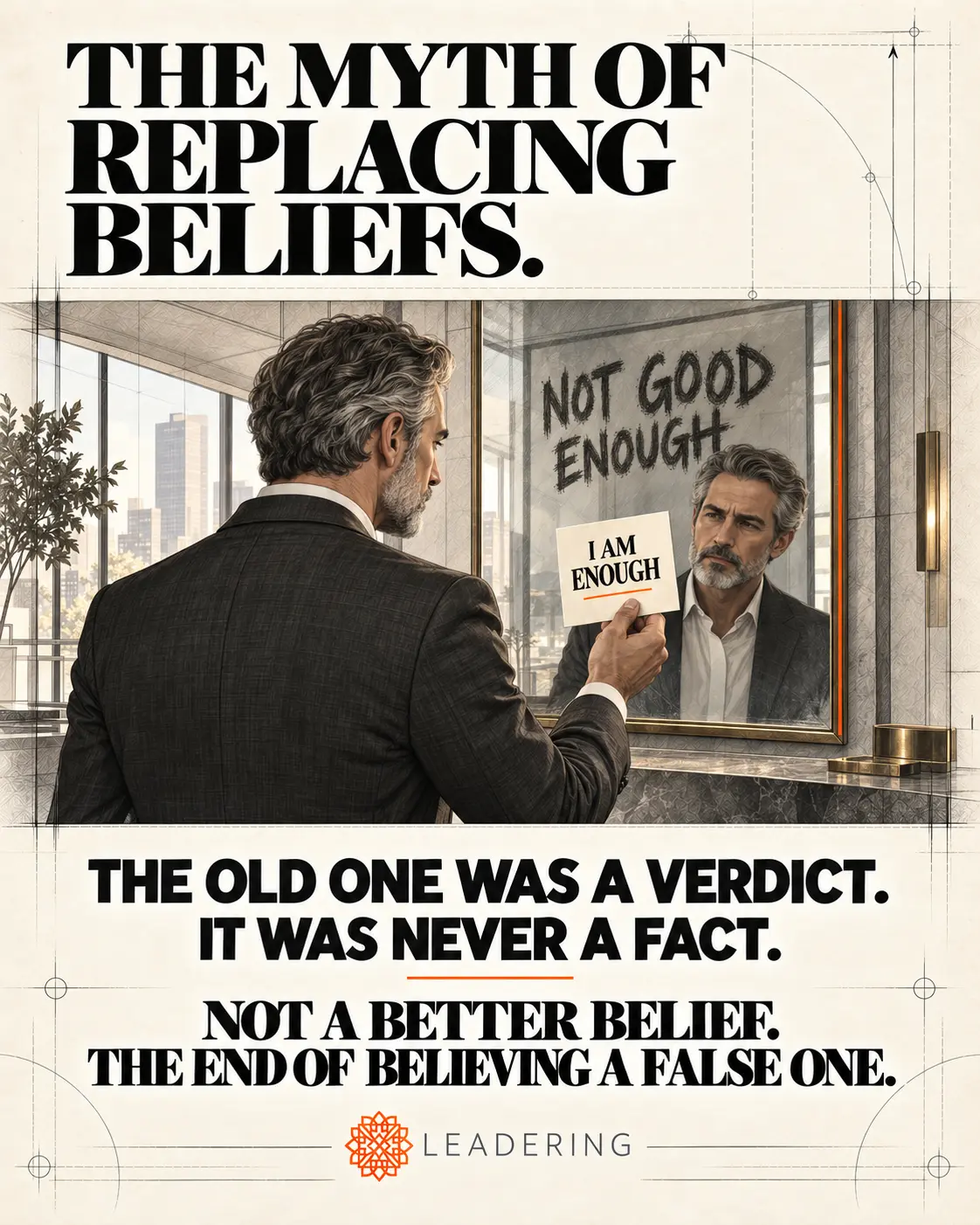
You did the exercise. You identified the belief underneath the thing you keep doing. I am not good enough. I have to earn my place. People leave. And then you wrote the replacement. I am enough. I belong here. People stay.
You said it in the mirror, or put it on a card, or repeated it every morning for a month.
And six months later, in the board meeting, the old one was the one that showed up.
That is not a failure of effort. It is what happens every time, because the premise does not hold. Here is why.
Start with what a belief is made of. It is a thought. The same material as every other thought your mind produces. Your mind produces thoughts the way a spring produces water, continuously and without permission, and you cannot pull one kind of thought out of a mind that produces thoughts all day. There is no extraction mechanism.
So the old one does not leave. Ever. It was installed a long time ago, when something happened that a much younger version of you could not make sense of, and it has been there every day since. Nothing you write on a card reaches that.
Now look at what the replacement actually is. You built it the same way the old one was built: as a strategy. A sentence adopted to fix something. And a sentence adopted to fix something behaves exactly like the sentence it was meant to fix. It fights the old one on the old one's ground, and it wears you out. I know this because I tried it myself for years as a young man, and what I built was not freedom. It was one more strategy, at war with the first.
Here is the part that makes the whole approach beside the point. You only think, speak, and act on things you believe are true. That is what believing means. So the reason the old sentence has been running your decisions is not its content. It is that you have held it as true, without ever once checking.
And it was never true. It was a conclusion reached by a very young person, standing in a moment that hurt, without the equipment to reach a fair one. A verdict, not a fact. It has been carried as a fact ever since, and that is the whole of its power. A replacement does not touch that. It hands you a second sentence to hold the same way, which is the same machine with better copy.
Which points at what actually changes things, and it is not a new belief.
It is seeing the old one for what it is. Not fighting it. Not fixing it. Not swapping it out. Seeing, for yourself, that what it said you were was never true to begin with.
You cannot install that. Understanding is not adopted. It dawns. But once it has, something changes that no replacement delivers. The old thought still arrives. It still sounds certain. And you let it be, not through effort or restraint, but because you do not act on things you can see are false. You stop being the person it describes, not because you are holding yourself back, but because you have seen that you never were.
That is the whole difference. Not a better belief. The end of believing a false one.
Back to all articles